
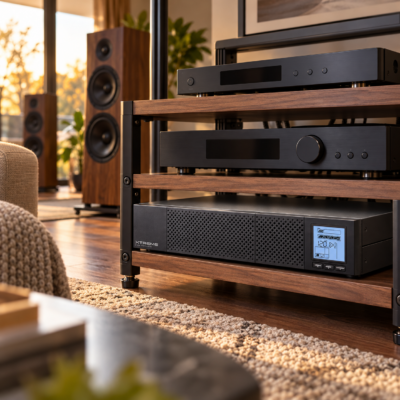
A simple question: Do power conditioners really matter for home audio?
A simple answer: Yes!
The right power equipment can help protect a home audio system and keep it operating reliably. Whether a power conditioner changes what you hear depends on the electrical problem, the audio equipment, and the features the conditioner actually provides.
That distinction matters when planning an installation. A homeowner may picture a power conditioner as an accessory that improves sound. An integrator also needs to consider protection from electrical disturbances, equipment restarting after an outage, and the power requirements of everything in the rack.
For a connected audio system, that includes the streaming player, network equipment, control processor, and amplifiers. A brief interruption can affect several parts of the listening experience.
The useful question is what the system needs its power equipment to do. Xtreme Power Conversion offers several approaches, from surge-protected distribution to voltage regulation and battery backup. However, before you make a selection, it’s best to first understand their different roles.
>
What is Power Conditioning?
The term “power conditioner” can describe products with substantially different capabilities. The name alone does not tell you whether a device filters interference, regulates voltage, or supplies backup power. Depending on the make and model, a power conditioner can limit transient voltage and/or provide battery backup as indicated in the below chart:
>
| Function | What it does | What to keep in mind |
|---|---|---|
| Surge suppression | Limits transient voltage spikes reaching connected equipment. | Does not provide power during an outage. |
| EMI and RFI filtering | Reduces specified types of electromagnetic and radio-frequency interference carried on the power line. | Does not address every source of audible hum or buzz. |
| Voltage regulation | Corrects high or low input voltage within a defined operating range. | A surge protector does not necessarily include this function. |
| Battery backup | Supplies power to supported equipment during an interruption. | Capacity and runtime depend on the UPS and connected load. |
| Power sequencing | Starts and stops groups of equipment in a planned order. | Does not increase the capacity of the electrical circuit. |
>
These functions can appear together in one product or be provided by separate devices selected for the installation. Power distribution itself simply provides multiple connection points; additional protection and control features vary by model.
>
Audible Improvement Depends on the Problem
Let’s start with the basics… Power conditioning won’t provide deeper bass, greater detail, or a wider soundstage. Likewise, if the equipment already operates quietly and correctly, adding a conditioner may produce little or no audible change.
However, if interference entering through the AC supply is affecting the audio, appropriate filtering may help. Likewise, a persistent hum can also be fixed with quality power conditioning hardware.
Ground loops and the way components are interconnected can introduce noise into the signal path and, unfortunately, an ordinary AC filter will not necessarily resolve those problems. The common fix of removing a power cord’s protective ground pin is also not a solution — it may fix the problem, but it will create an unsafe operating environment and almost always void warranties.
>
Match Xtreme Power Equipment to the Hi-Fi Installation
Future Ready Solutions offers Xtreme Power products for several levels of power management and, ultimately, audio system integrity. The appropriate choice depends on the electrical conditions, the connected equipment, and what needs to happen when utility power is interrupted.
XPDS for Surge Protection and Rack Distribution. For a system that primarily needs organized power distribution and surge protection, the Xtreme Power XPDS series provides a straightforward starting point. Future Ready Solutions offers 15-amp and 20-amp versions with 10 outlets, rack or vertical mounting options, and an indicator that reports the status of the surge protection. The XPDS series distributes power while reducing exposure to voltage spikes.
P80 for Voltage Regulation and Battery Backup. The Xtreme Power P80 series combines a line-interactive uninterruptible power supply (UPS) with automatic voltage regulation and pure sine wave output. Its regulation can correct certain high or low input-voltage conditions without drawing on the battery. When utility power fails, the battery supplies the supported load for a limited period. That combination makes the P80 a candidate for hi-fi source components, control equipment, and networking devices that need both voltage support and outage protection.
P91 for Continuous Online Power Conversion. The Xtreme Power P91 series uses online double conversion. During normal online operation, incoming AC is converted to DC and the output is supplied through an inverter. This provides continuous power conditioning and zero transfer time when moving from normal online operation to battery power. An integrator may consider this approach when the site’s power conditions or the connected equipment justify continuous conversion and uninterrupted transfer to battery.
TXVR for Larger Installations Requiring Isolation and Regulation. The Xtreme Power TXVR is a dedicated conditioning option that combines electronic voltage regulation with galvanic isolation and surge suppression. It provides laboratory-grade performance for systems with voltage fluctuations and grounding or noise issues.
>
Lowell Adds Power Sequencing and Organization
 A home audio rack may also benefit from controlling how equipment starts and stops. In a system with separate sources, processing, and amplification, an installer can plan the sequence so upstream equipment is ready before the amplifiers turn on, with the reverse order at shutdown. This can reduce startup and shutdown pops.
Lowell Manufacturing’s rack and power products complement the Xtreme Power range available through Future Ready Solutions. For example, the Lowell ACSPR-SEQ4-1509 combines surge protection, EMI/RFI filtering, and a four-step sequencer in a rackmount power panel. For an integrator, that provides a way to address filtering, protection, and startup control together.
Lowell’s racks and accessories support the physical installation with comprehensive equipment organization and access.
>
Amplifiers Deserve Their Own Power Assessment
Power conditioning and distribution must support the equipment connected to it with particular attention paid toward amplifiers and powered subwoofers.
An amplifier’s advertised watts per channel describe audio output. They are not enough to size its AC power source. Use the manufacturer’s input-power requirements and consider startup current as well as demand during operation. Some amplifiers draw a substantial, brief inrush current when switched on, which can matter when selecting a UPS or starting several components together.
For a UPS, check its watt and volt-ampere limits, load compatibility, and the manufacturer’s runtime data. Connecting more equipment increases demand and reduces backup time.
One practical design approach is to put compatible networking, streaming, and control equipment on appropriately sized battery backup while providing the amplifiers with suitable surge protection and electrical capacity. This can preserve the devices needed to recover smoothly after a brief interruption without sizing the battery system to run every amplifier.
>
Include Placement and Service in the Design
Electrical specifications are only part of the selection process — location also matters. A UPS may be great in the rack, but it won’t meld into the residential listening environment.
When designing a system, pay attention to the power equipment’s cooling fans, alarms, and acoustic specifications, and choose a location that works for the room. Reputable manufacturers like Xtreme Power publish audible-noise specifications for hardware, making it easy to identify what works in an isolated rack and what’s suitable for direct integration in living spaces.
Plan for ventilation, battery access, labeled outlets, and enough space to service connections. Include battery checks and replacement planning in the service schedule, and periodically inspect protection-status indicators. Confirm that the product’s plug, circuit requirements, and total connected load suit the installation. If a PDU will be used with a UPS, follow both manufacturers’ connection requirements.
>
Specify Power Equipment Around a Clear Purpose
Power conditioners matter when their capabilities match the needs of the home audio system. A useful proposal should explain what each device contributes, which components it serves, and what the owner can expect during an electrical disturbance.
For one installation, that may mean surge-protected distribution. Another may benefit from filtering and sequencing. A connected audio system may justify voltage regulation and battery backup for selected devices. More demanding installations may require continuous online conversion or transformer isolation.
Future Ready Solutions merges Xtreme Power protection and UPS products with Lowell rack solutions to support those decisions. Contact Future Ready Solutions to discuss the equipment load, installation conditions, and level of protection appropriate for your next home audio project.