
This original Future Ready Solutions article was informed in part by the Kordz technical resource, “Shielded vs Unshielded Network Cable: What Should You Specify and When?”, published June 17, 2026. View the original article in its entirety here.
>
For many integrators, selecting Ethernet cable starts with a familiar question: Cat6 or Cat6A?
Cable grade is important, but it is only part of the specification. Integrators must also decide whether the cable should be shielded or unshielded.
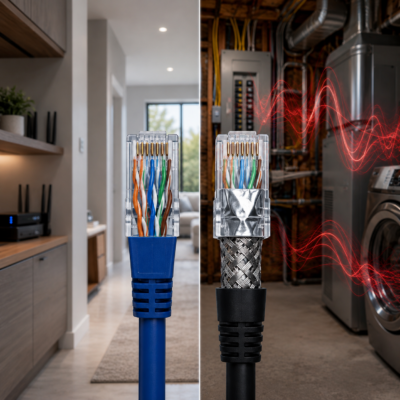
The common assumption is that shielded cable is automatically the safer, more professional and higher-performance choice. In reality, shielding is not a universal upgrade. It is a construction feature intended to address a specific problem: electromagnetic interference.
When credible interference is present, shielding can help protect network reliability. When it is not, shielded cable may add cost, consume more pathway space and make installation more complicated without producing a meaningful benefit.
The right question is not, “Which cable is better?” It is, “What does this particular cable pathway require?”
>
Shielding Is Not a Speed Upgrade
Cable category and cable shielding describe two different characteristics.
The category—Cat6, Cat6A and so on—defines the cable’s electrical performance. It helps determine the data rates, frequencies and distances the cable can support.
The shielding designation describes the cable’s physical construction and how it manages interference.
A shielded Cat6 cable is still a Cat6 cable. It does not become Cat6A because it has foil around the conductors. Conversely, unshielded Cat6A cable exists and can meet Cat6A performance requirements without being part of a shielded system.
Category should therefore be selected according to the application, required bandwidth, link distance and anticipated service life. Shielding should be selected according to the electrical environment surrounding the cable route. Future Ready Solutions’ partner Kordz makes the same distinction in its technical guidance: shielding protects against interference but does not raise a cable’s category or speed.
>
What Shielding Actually Does
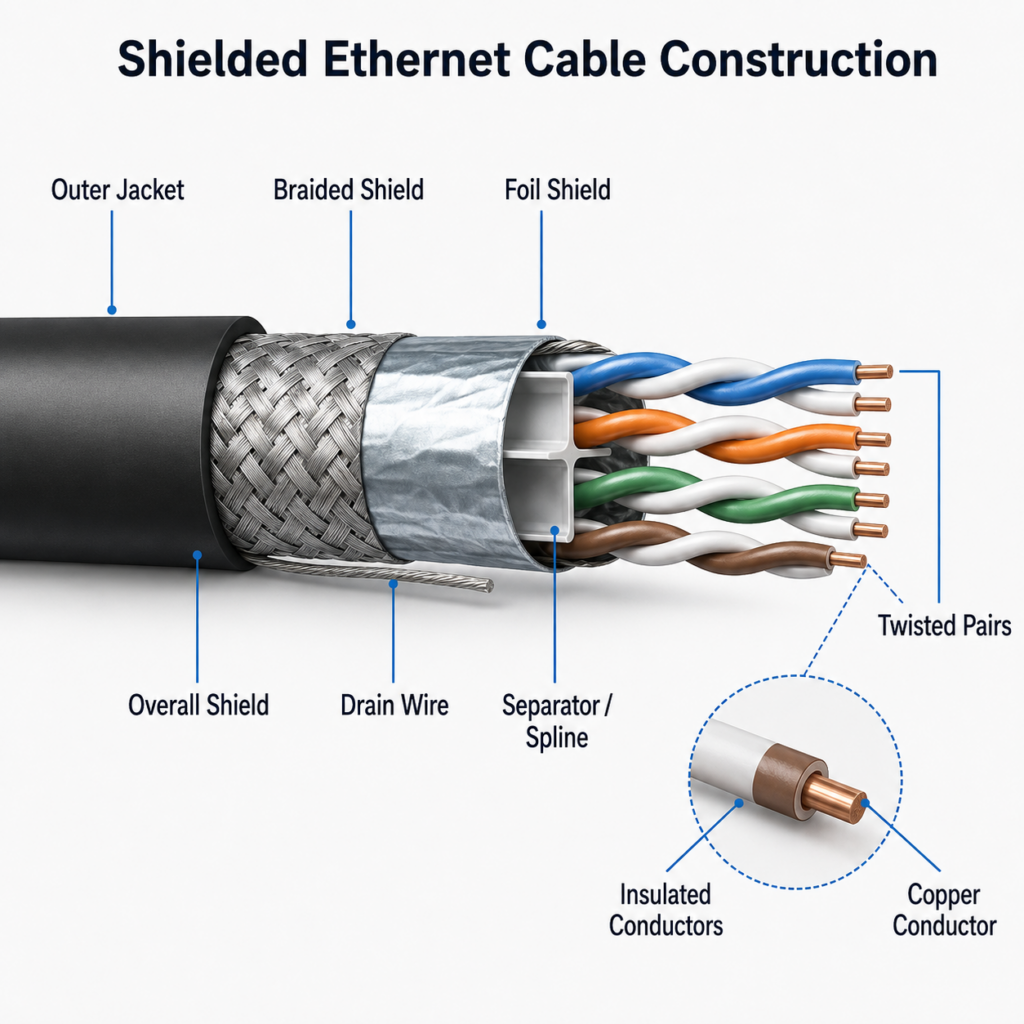 Copper Ethernet cable transmits data over balanced twisted pairs. The twist geometry helps reject noise that is coupled equally onto the conductors, which is one reason properly designed unshielded cable works reliably in most homes and many light-commercial environments.
A shield adds another layer of protection. Depending on the construction, foil or braided material surrounds either the complete group of pairs, the individual pairs or both. That conductive barrier reduces the influence of electromagnetic interference on the data signal. It can also reduce the amount of electromagnetic energy emitted by the cable itself.
Potential interference sources include:
- High-current electrical conductors
- Motors and variable-frequency drives
- HVAC equipment and elevator machinery
- Transformers and large power supplies
- Lighting control and phase-cut dimming equipment
- EV charging infrastructure
- Generator and plant equipment
- Congested pathways shared with other voltage carrying cables
In an audio-visual or smart-building system, interference may not produce a complete and obvious failure. It can appear as intermittent link drops, packet errors, unreliable control, video interruptions or devices that work during commissioning but behave unpredictably after the system is fully loaded.
Those symptoms can consume hours of troubleshooting because they often resemble switch, endpoint, connector or configuration problems.
Shielding can reduce that risk, but it cannot repair poor workmanship. It does not compensate for excessive untwist, damaged conductors, incorrect pinouts, low-quality connectors or badly planned cable routes. Physical separation from power and other interference sources should remain the first design response. Shielding is an additional protective measure — not permission to ignore good pathway design.
>
Understanding Ethernet Shielding Labels
“UTP” and “STP” are commonly used terms, but they do not always describe the actual construction precisely. The more specific designations identify shielding around the cable and around its individual pairs. Kordz identifies the following common constructions in its technical guidance.
| Designation | Construction | Typical use |
|---|---|---|
| U/UTP | No overall shield and no pair shields | Residential, standard commercial and other low-interference pathways |
| F/UTP | Foil shield around all four pairs | Moderate-interference environments and many Cat6A systems |
| U/FTP | Individual foil shield around each pair | Applications requiring greater pair isolation and crosstalk control |
| S/FTP | Overall braided shield plus foil around each pair | High-interference and specialized installations |
The letter before the slash describes the overall cable shield. The letters after the slash describe the shielding around the twisted pairs.
This distinction matters during specification. Two cables marketed broadly as “shielded Ethernet” may have very different constructions, handling characteristics and termination requirements.
>
When Unshielded Cable Is the Right Choice
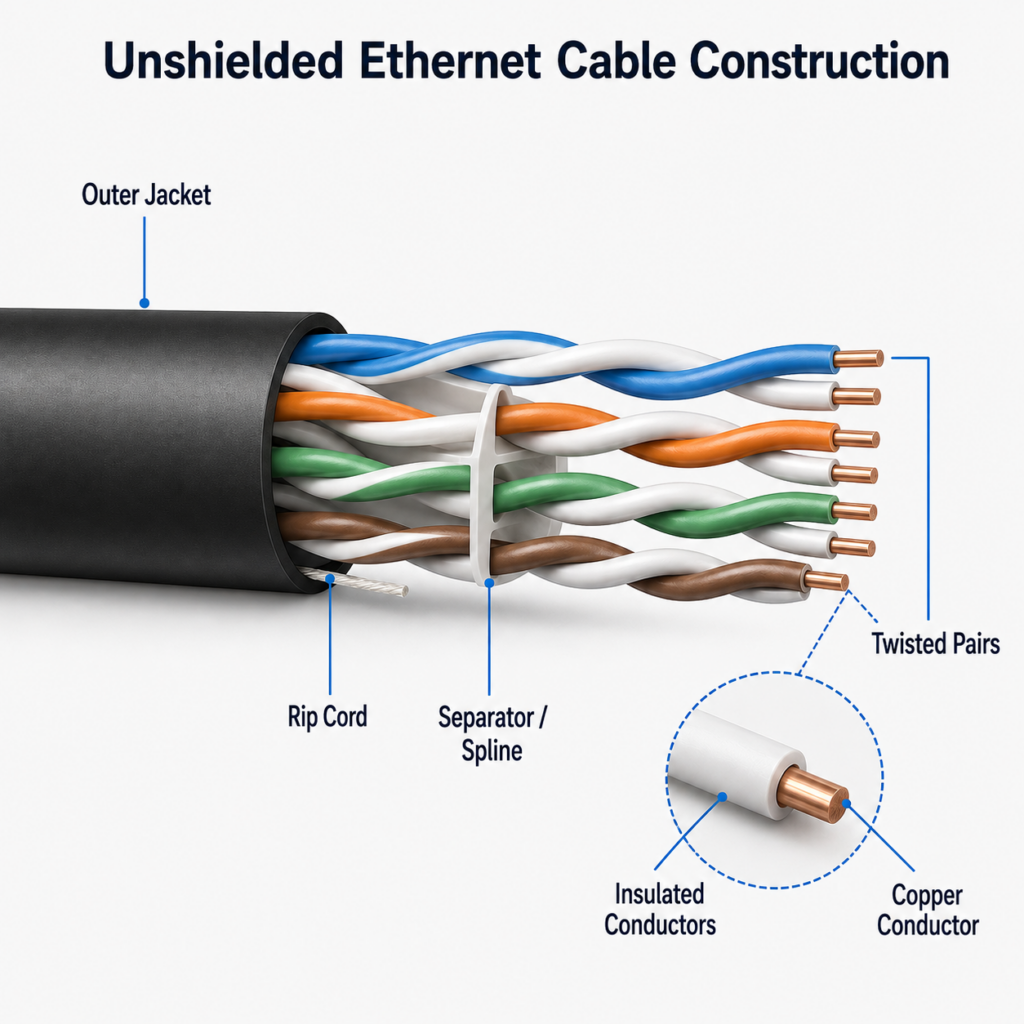 Unshielded cable is generally the correct choice when the pathway has a low risk of electromagnetic interference.
Examples include new residential construction with dedicated low-voltage routes, standard smart home installations, office network drops with appropriate separation from electrical wiring and access point or camera connections routed through clean ceiling spaces.
In these environments, a quality U/UTP cable provides several practical advantages:
- Smaller cable diameter
- Greater flexibility
- Easier pulling through conduit and confined pathways
- Faster, more familiar termination
- Lower material and labor cost
- No shield continuity or bonding requirements
Choosing unshielded cable in a low-risk environment is not value engineering at the expense of performance. It is an appropriate response to the actual installation conditions.
In fact, overspecifying shielded cable can make a project less reliable when installers do not have the correct connectors, tools or grounding strategy. A properly installed unshielded channel is preferable to an inconsistently terminated shielded channel.
>
When Shielded Cable Earns Its Place
Shielded cable should be considered when the cable route passes through an environment with identifiable interference sources and adequate separation cannot be maintained.
Common examples include data cabling that must pass near lighting control equipment, AV racks with concentrated power and amplification equipment, shared risers with unpredictable electrical services, plant rooms, elevator or HVAC infrastructure and retrofit pathways where power and communications cabling cannot be separated as effectively as they would be in new construction.
The decision should be made pathway by pathway.
A large residence, for example, may have clean cable routes throughout most living spaces but a higher-risk route near an equipment room or mechanical area. There may be no technical reason to make every network drop shielded simply because one section of the building contains significant electrical infrastructure.
This pathway-specific approach controls cost while applying additional protection where it creates true value.
>
A Shielded Cable Must Be Part of a Shielded Channel
One of the most important shielding principles is also one of the most frequently overlooked: a cable’s shield must remain continuous through the connectivity system. Simply, specifying shielded bulk cable isn’t enough.
A properly designed shielded channel typically includes:
- Shielded bulk cable
- Compatible shielded plugs or keystone jacks
- Shielded patch panels
- Shielded patch cords
- Properly grounded and bonded connectivity infrastructure
Terminating shielded cable onto an unshielded keystone or using unshielded patch cords within the channel compromises the shielding design. Improperly handled foil, drain wires or connector shells can create the appearance of a shielded installation without delivering its intended protection. Kordz consequently recommends treating shielding as an end-to-end channel decision rather than a cable-only decision.
Grounding and bonding also require deliberate planning. Integrators should follow the cable and connectivity manufacturer’s instructions, the project’s telecommunications bonding design and applicable electrical requirements. Improvising the grounding method or assuming the network equipment will automatically provide an effective bonding path can undermine the design.
Testing is equally important. A simple direct-current continuity test can sometimes follow an alternate path through grounded racks and building infrastructure, falsely indicating that a cable shield is intact. Certification equipment capable of testing shield integrity along the actual cabling path provides greater assurance that the shield has been terminated correctly.
>
PoE Does Not Automatically Require Shielded Cable
The growth of PoE cameras, wireless access points, interactive control panels and lighting devices creates another common misconception: high-power PoE must use shielded cable. The reality is cable shielding and PoE address different engineering concerns.
Shielding primarily manages electromagnetic interference, whereas PoE performance is affected by conductor material, conductor size, DC resistance, cable length, ambient temperature, bundle size, connector quality and installation conditions.
A shielded cable with undersized conductors or questionable copper quality is not automatically a better PoE cable. Likewise, a properly designed unshielded cable can support demanding PoE applications when it is rated for the required power level and installed within the manufacturer’s limitations.
Kordz specifically advises that shielding decisions be driven by EMI exposure rather than PoE alone. It identifies conductor size, cable quality, bundling and installation practice as more influential PoE considerations.
Integrators should evaluate PoE and shielding separately, then select a cable system that satisfies both requirements.
>
A Practical Specification Process
Rather than defaulting every project to shielded or unshielded cable, integrators can use a repeatable five-step process.
1. Define the application. Determine the required network speed, transmission distance, PoE load and expected service life. This establishes whether Cat6, Cat6A or another medium is appropriate.
2. Review the complete pathway. Evaluate where the cable will travel, not just the equipment at each end. A clean rack does not eliminate interference encountered halfway through the route.
3. Identify credible interference sources. Look for high-current wiring, motors, dimming systems, transformers and other sources of electromagnetic and RF interference.
4. Improve separation first. Reroute the cable, use a dedicated pathway or increase separation wherever practical. Shielding should supplement good routing rather than replace it.
5. Specify and test the complete channel. When shielding is justified, select compatible cable, connectors, jacks, patch cords and patch panels. Document the bonding strategy and verify both category performance and shield integrity.
>
When the Better Answer Is Fiber
There are environments where the decision should not be between shielded and unshielded copper. For pathways exposed to severe electromagnetic interference, long distances or challenging industrial infrastructure, fiber may provide a more robust architecture. Because optical fiber carries light rather than an electrical signal, it is immune to electromagnetic interference.
A fiber backbone can carry the network through the hostile or long-distance portion of the route, followed by a short copper connection for the endpoint when PoE is required. This can be especially useful for remote buildings, security systems, outdoor infrastructure and industrial applications.
The broader design lesson is important: shielding is one available tool, not the answer to every difficult pathway.
>
Matching the Kordz System to the Installation
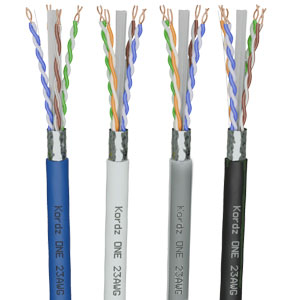 Future Ready Solutions offers Kordz networking systems for both shielded and unshielded applications.
For conventional home runs and low-interference environments, the Kordz ONE Cat6 U/UTP Network Cable provides an unshielded 24 AWG structured cabling option. The Kordz PRO SlimCat Cat6 System offers a compact U/UTP alternative for shorter runs, high-density installations and constrained pathways.
Where Cat6A performance and overall shielding are appropriate, the Kordz ONE Cat6A F/UTP Network Cable provides a traditional 23 AWG shielded construction. For tighter spaces, the Kordz PRS SlimCat Cat6A Network Cable combines F/UTP shielding with a 5 mm cable diameter and matching shielded connectivity for permanent links up to 50 meters.
The value of a matched system is not merely convenience. It helps ensure that the cable, terminations and patching components support the same performance and shielding strategy from one end of the channel to the other.
>
Specify for the Environment, Not the Assumption
Shielded cable is valuable when a project contains a credible interference risk. Unshielded cable remains the practical and technically correct choice for many residential, commercial AV and smart-building installations.
Neither construction is universally superior.
The professional approach is to choose the cable category according to the application, choose the shielding according to the pathway and install the entire channel according to one consistent design. That discipline avoids both underspecification and unnecessary complexity—and produces networks that remain reliable long after commissioning is complete.
>
This original Future Ready Solutions article was informed in part by the Kordz technical resource, “Shielded vs Unshielded Network Cable: What Should You Specify and When?”, published June 17, 2026. View the original article in its entirety here.