
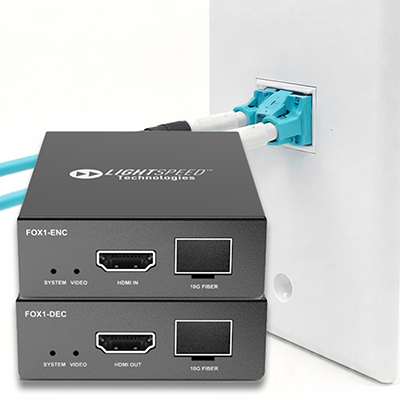
Extending HDMI over fiber has become a standard design approach in commercial AV, residential AV, digital signage and other environments where distance, signal integrity and EMI immunity are critical. Compared to copper-based HDMI or HDBaseT applications, fiber provides dramatically longer distances, higher bandwidth headroom and superior reliability in electrically noisy environments—factors that align with modern 4K/8K video distribution and networked AV systems.
Additionally, HDMI over fiber installations address future needs thanks to the unlimited data rate potential and versatility of fiber optic cable — simply replace extenders to transform the cable run for networking, ISP, AV over IP or whatever ultra-high resolution platform comes next.
This article explores HDMI over fiber products and practical, real-world deployments.
>
Why Use Fiber to Extend HDMI?
When used together, fiber optic cabling and fiber-based HDMI extenders offer several key benefits over legacy copper-based systems.
- Signal extension distance. Traditional HDMI cables support signals up to 50 feet reliably, and active optical HDMI cables and twisted pair extenders support up to 100m (328 ft) reliably. Fiber-based HDMI extender reliably support up to 300m (984 ft) on multimode fiber and 10 km (6.2 miles) on single mode fiber.
- Immunity to electromagnetic and RF interference. Fiber optic cabling is non-conductive, making it ideal for noisy environments and cable runs near sources of interference, including motors, large appliances, air handling equipment and fluorescent lighting. The cable paths that wreak havoc on traditional twisted pair extensions have no effect on fiber-based systems.
- Immunity to static electricity, surges and other power problems. Fiber eliminates ground loops and reduces the risk of surge damage—an important consideration in large buildings, historic properties and outdoor runs.
- Higher bandwidth and future readiness. Fiber supports uncompressed 4K and 8K even over the longest cable runs. Plus, it’s scalable and forward-ready for future upgrades and applications.
>
How HDMI over Fiber Extenders Operate
Similar to HDMI over twisted pair applications, fiber-based extenders leverage a transmitter and receiver pair to convert electrical signals into optical signals and back again.
For example, the LightSpeed FOX1 kit includes a transmitter, receiver, power supplies and swappable fiber transceiver modules that provide flexibility for both multimode and single mode fiber.
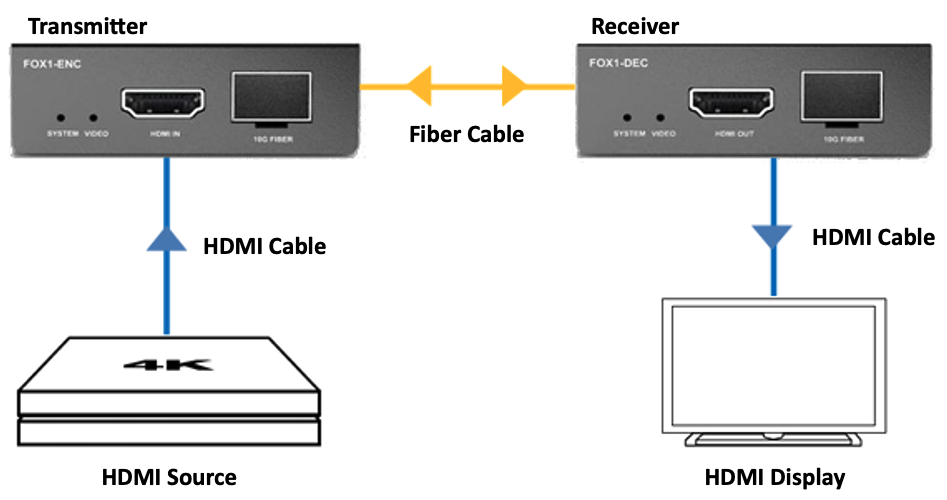
The basic installation and signal flow is:
- The HDMI source connects to the fiber-based transmitter and the HDMI display connects to the fiber-based receiver. If necessary, corresponding SFP+ transceiver modules are used.
- The fiber optic cable carries the signal from the source to the display, including bi-directional protocols such as HDCP and CEC.
This architecture allows installers to leverage a broader structured fiber cabling infrastructure which also accommodates fiber for networking or internet distribution.
>
Capabilities Support Real-World Installations
 In addition to the LightSpeed FOX1 kit mentioned above, a variety of different HDMI over fiber extenders are available featuring different form-factors and signal capabilities.
For example, AVPro Edge offers extender kits supporting 8K HDMI with built-in USB, ethernet, IR and RS232 extension.
Select AVPro Edge models even include video scaling for compatibility with different display types and mounting brackets for flexible integration and security.
>
Getting Started
Most HDMI over fiber extension systems require either simplex (one strand) or duplex (two strand) fiber optic cable. It’s best practice to install a minimum of two strands per run; however, 4 – 6 strands are preferred for future expansion and upgrades.
Additionally, some extenders are specific to either multimode or single mode fiber with either LC or SC fiber connector types. It’s best practice to select an extender kit and then specify the cabling and connectors based on its capabilities.
If you’re new to fiber-based designs and integrations, Future Ready Solutions offers a variety of articles on fiber optics and installation best practices. Learn more at www.futurereadysolutions.com.