
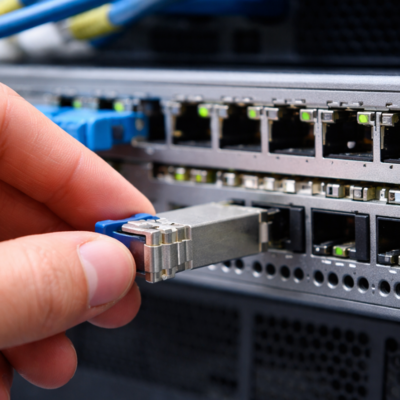
As audio-visual installations continue to rely on high-speed networking, choosing the right interconnect method inside racks and between devices has become a critical design consideration. Historically, integrators simply connected RJ45 ports with quality cabling; however, thanks to the increase in fiber optic cabling and fiber-enabled devices, there are multiple connectivity options depending on the installation footprint and data rate requirements.
This article explores the three most common methods of connecting fiber-based devices and connectivity hardware: transceivers with fiber cabling, direct attach copper (DAC) cables, and active optical cables (AOCs). While all three serve the same fundamental purpose — moving data between switches, servers, media converters, extenders and AV over IP extenders — their performance characteristics, cost structures and deployment scenarios differ significantly.
Understanding these differences will help you optimize your installation’s performance, scalability, power consumption and total cost of ownership.
>
Transceivers
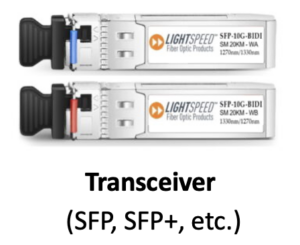 A transceiver is a modular device that converts electrical signals into optical signals (and vice versa). By doing so, transceivers enable switches, media converters and other fiber-enabled devices to connect to multimode and single mode fiber optic cable.
Transceivers are available in a variety of form-factors and data rates — and often they are referenced based on their capability. The below list includes form-factors commonly used in audio-visual installations:
- SFP (small form-factor pluggable) = 1 Gbps maximum data rate
- SFP+ = 10 Gbps maximum data rate
- SFP28 = 25 Gbps maximum data rate
- QSFP+ (quad small form-factor pluggable) = 40 Gbps maximum data rate
- QSFP28 = 100 Gbps maximum data rate
Unlike DAC cables and AOCs which we’ll explore later, transceivers require a separate fiber patch or trunk cable. While this provides maximum flexibility in system design, it often increases the overall cost of the project and drives slightly higher power consumption during system operation.
>
Direct Attach Copper (DAC) Cables
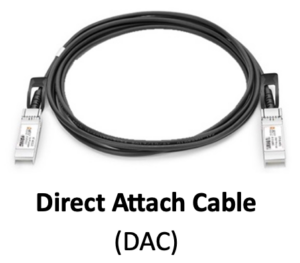 A direct attach copper cable is a twinax copper cable with fixed connectors permanently attached to each end. It connects directly to fiber-based electronics without the need for separate transceivers. By doing so, DAC cables are the most cost-effective solution for short-distance connections.
Think of a DAC cable as a fiber optic patch cable factory-terminated with transceivers — and in practice, it looks and operates in much the same way. DAC cables deliver simple plug-and-play installation without the need to terminate or clean optical cabling.
This simple, all-in-one construction makes DAC cables less expensive than separate transceivers and patch cables; however, distances are typically limited to 7m / 23ft and the cable is bulkier and less flexible than traditional multimode or single mode fiber.
Additionally, DAC cables require less operational power than transceivers, delivering lower overall system power consumption.
DAC cables are not intended for structured cabling or in-wall installation — they are typically used for patching within a rack or between devices in adjacent racks.
>
Networking Active Optical Cables (AOC)
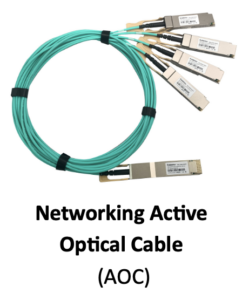 Active optical cables are similar to DAC cables in that they are all-in-one, factory-terminated assemblies that provide quick plug-and-play connectivity. However, instead of copper cable they leverage a fiber optic core that allows for higher data rates and longer distances.
AOCs deliver many of the performance advantages of fiber while maintaining the simplicity of a single cable solution.
For example, AOCs connect devices up to 100m / 330ft in distance and can be installed in walls and plenum spaces. They are also immune to electromagnetic interference, are lightweight and flexible, and provide maximum data rates up to 800 Gbps.
Additionally, the all-in-one construction of AOCs requires less operational power than transceivers.
>
Audio-Visual Active Optical Cables
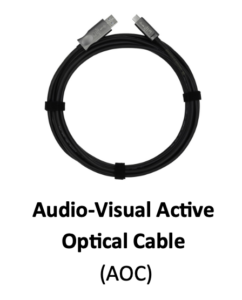 The same fiber-based technology used in network-focused AOCs can also be applied to audio-visual applications.
Active optical technology facilitates long-distance, factory-terminated HDMI and USB cables that support the latest high-bandwidth signals including 8K / 10K and SuperSpeed USB 3.2.
The Kordz PRO4 Series extends uncompressed 48G HDMI up to 100m without the need for extenders or boosters. Plus, the internal fiber construction delivers electromagnetic immunity with an overall cable diameter of only 4.7mm.
The Bullet Train 8K/10K Series provides similar performance and overall cable lengths with the added benefit of internal Cleerline SSF fiber, providing improved cable strength, bend radius, pull tension and durability. Plus, thanks to the Bullet Train SSF construction, the fiber can be repurposed in the field for future networking applications.
The Kordz PRO Series extends 10G USB 3.2 Gen2 and 60W power up to 10m without the need for extenders or booster. Plus, a unique polycarbonate snouted connector design is rated for up to 10,000 connections.
For the benefits stated above, AOCs built for HDMI and USB have become one of the most popular solutions for in-wall and longer distance connectivity.
>
Side-by-Side Comparison of Solutions
| Feature | Transceiver + Fiber | DAC | AOC |
|---|---|---|---|
| Distance | Up to 80 km+ | Up to 7m | Up to 100m |
| Cost | Highest | Lowest | Moderate |
| Power Consumption | Moderate | Lowest | Low |
| Latency | Low | Lowest | Low |
| Flexibility | Highest | Low | Moderate |
| Weight | Light | Heavy | Light |
| EMI Immunity | Yes | No | Yes |
| Replaceability | Replace components separately | Replace entire cable | Replace entire cable |
| Structured Cabling | Yes | No | Yes |
>
Future Ready Solutions offers a wide variety of transceivers and fiber optic patch cords, DAC cables and AOCs. Additional information is available online at FutureReadySolutions.com.